May 15, 2026
Try in ChatGPT(opens in a new window)
Loading…
Update on June 25, 2026: The personal finance experience in ChatGPT is now available to Plus and Pro users in the U.S. on web, iOS, and Android.
Today we’re releasing a preview of a new personal finance experience in ChatGPT to Pro users in the U.S. Now you can securely connect your financial accounts, see a dashboard of where your money is going, and ask ChatGPT questions grounded in your financial context – all while staying in control of your data. We’re starting with a preview to a smaller group so we can learn from real-world use, improve the experience, and expand thoughtfully.
Money touches nearly every part of life: where we live, what decisions we make, how we care for loved ones, what future we imagine. But managing finances today often means piecing together accounts, apps, cards, loans, and spreadsheets just to know where things stand. Even then, it can be hard to see the full picture or know what to do next.
People are already turning to ChatGPT for help: more than 200 million people come to ChatGPT(opens in a new window) every month for budgeting, questions about their investments, comparing different paths, planning for future goals, and more. Recent advances in GPT‑5.5 make ChatGPT stronger at reasoning through the complex, context-dependent questions that personal finance often requires.
With your financial accounts connected, ChatGPT can combine that reasoning with your real financial context and what you’ve shared about your goals, lifestyle, and priorities, helping you spot patterns, understand tradeoffs, and plan for big decisions in a way that feels more personal and complete. Now you can ask questions like:
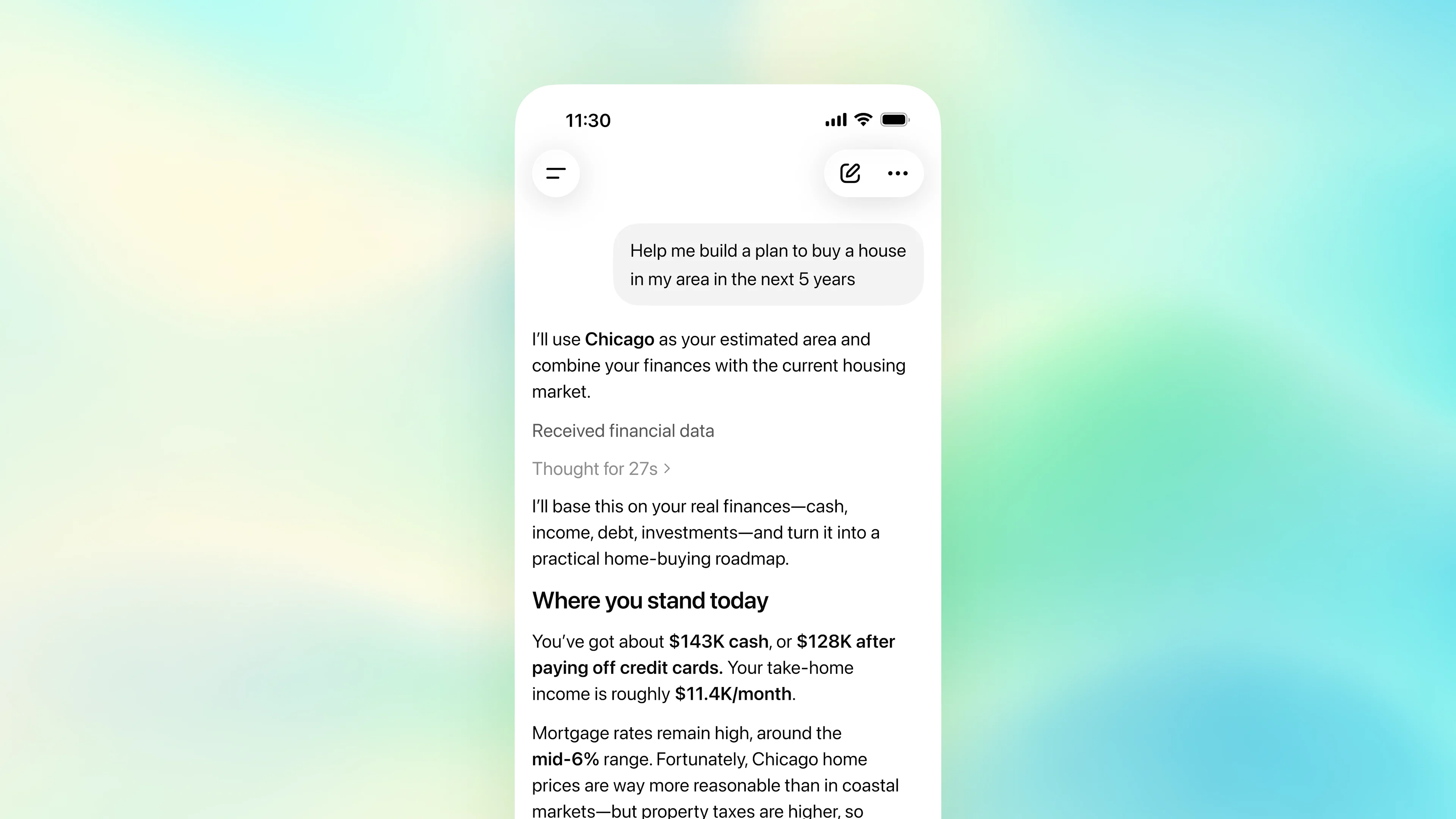
ChatGPT can help you stay informed and feel more confident managing your finances, but it is not a replacement for professional financial advice.
Starting today, we’re rolling out the ability for Pro users in the U.S. to connect their financial accounts in ChatGPT on web and iOS, with support for more than 12,000 financial institutions. We’ll learn and improve from early use before rolling it out to Plus, with the goal of making it available to everyone.
How to get started
Connect your financial information
To get started, open Finances from the sidebar in ChatGPT and select ‘Get started’ or start a conversation from anywhere in ChatGPT by saying ‘@Finances, connect my accounts’.
ChatGPT will then guide you through securely linking accounts through Plaid, with Intuit support coming soon. After you authenticate, ChatGPT will begin syncing and categorizing your data, which may take a few minutes.
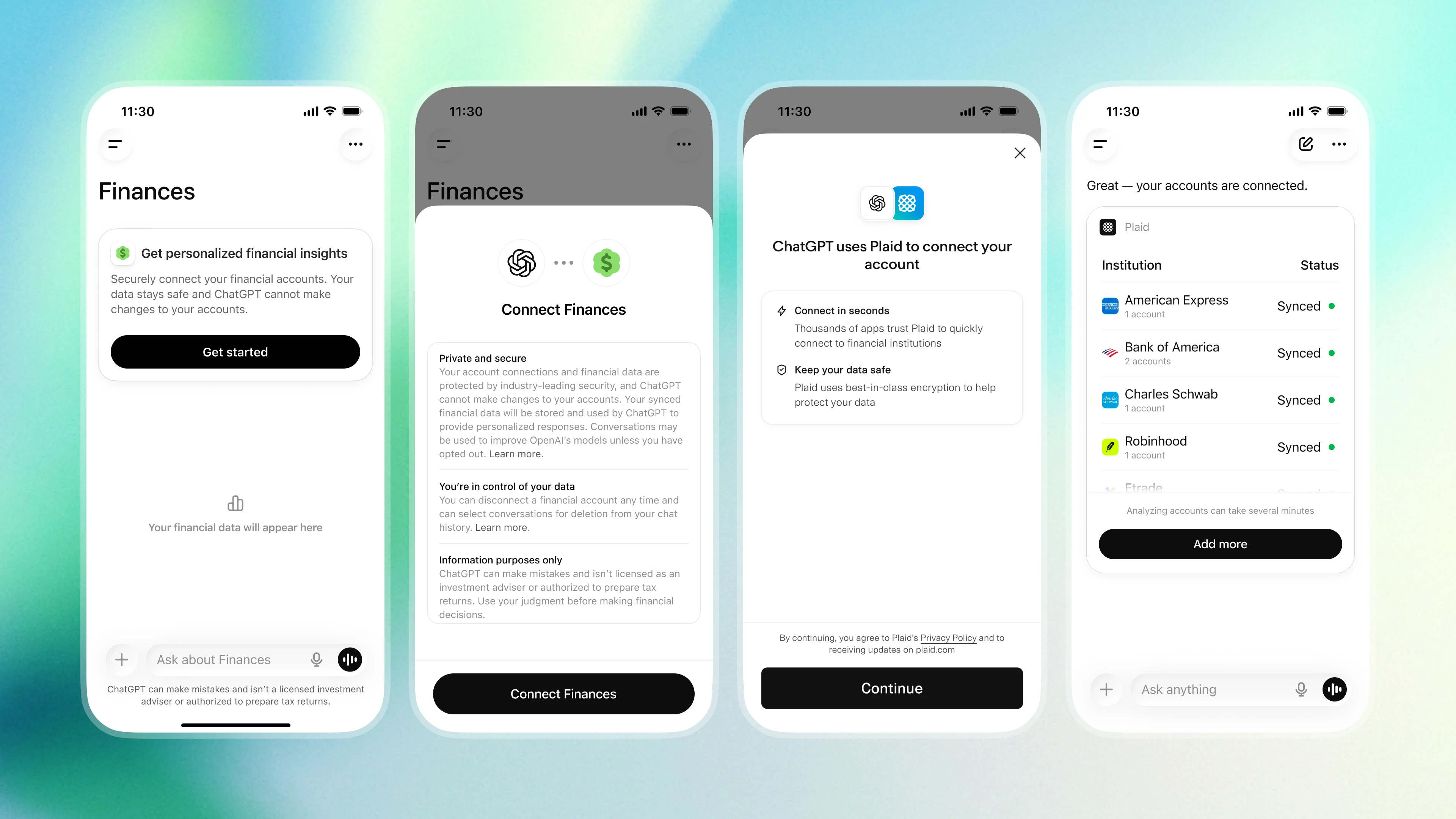
Once your accounts are synced, you can see a dashboard that gives you an up-to-date view of where you stand across portfolio performance, spending, subscriptions, upcoming payments, and more.
Beyond connected accounts, you can share important context about your financial life, like a mortgage, a savings goal, or a major purchase you’re planning for. For example, you might tell ChatGPT: “I’m saving up to buy a car early next year” or “I still owe my parents [X amount] for the loan they gave me.” ChatGPT can save that context to your Financial memories to inform future conversations.
That broader context is part of what makes this experience useful – instead of treating each question in isolation, ChatGPT can help connect the dots across your accounts, your goals, and what you’ve already shared, so the guidance is more personal and complete.
Without Finances connected
Help me come up with a plan to save a little bit more in the next few months.
Here’s a practical way to save a bit more over the next 2–3 months without making your life miserable.
- Pick a specific target
Make the goal concrete and time-bound.
Examples:
- “Save an extra $1,500 by August.”
- “Build a one-month emergency cushion.”
- “Save enough for travel / taxes / moving / investing.”
A vague goal like “spend less” usually fades quickly.
- Focus on the 3 highest-impact categories
Most people don’t need to optimize everything. Usually 70–80% of extra savings comes from a few categories:
Food & delivery
Good targets:
- Reduce takeout from 5x/week → 2x/week
- Bring coffee/lunch a few days per week
- Set a fixed “fun food” budget
Even a small reduction here can free up a few hundred dollars monthly.
Subscriptions & recurring charges
Look for:
- Duplicate streaming/services
- Annual plans you forgot about
- Apps you rarely use
- Higher-tier plans you don’t need
A 20-minute cleanup can permanently lower monthly burn.
Impulse spending
Instead of “don’t buy stuff,” use friction:
- 48-hour rule for purchases over a set amount
- Remove saved cards from shopping apps
- Keep a running wishlist instead of instant purchases
This cuts emotional purchases without feeling restrictive.
- Automate the saving immediately
The biggest difference-maker is usually automation.
Try:
- Automatic transfer every payday
- Separate high-yield savings account
- Move the money before you see it
Even:
- $75/week = ~$900 in 3 months
- $150/week = ~$1,800 in 3 months
Small consistent transfers beat occasional big efforts.
- Create one “low-spend default”
Don’t try to optimize every decision.
Examples:
- Weeknights = home-cooked meals
- One no-spend day per week
- Fixed entertainment budget
- Only one convenience purchase category at a time
Simple rules reduce decision fatigue.
- Increase income slightly instead of only cutting
For a short-term savings push, earning a little extra is often easier psychologically than aggressive budgeting.
Ideas:
- Sell unused gear/clothes/electronics
- Freelance or consulting work
- Small weekend project
- Negotiate a recurring expense (insurance, internet, phone)
Even an extra few hundred dollars changes momentum fast.
- Track only one number weekly
Avoid overcomplicated budgeting systems.
Every week, check:
“How much did my savings increase this week?”
That keeps attention on progress rather than guilt.
A realistic “light effort” version
If you want something sustainable and low-stress:
Monthly
- Cut 2–3 subscriptions
- Reduce dining out modestly
- Auto-transfer savings on payday
Weekly
- One no-spend day
- One meal-prep session
- Quick 5-minute money check-in
That alone can often create an extra few hundred dollars/month without dramatic lifestyle changes.
If you want, I can also help you build:
- a lean 3-month savings plan,
- a category-by-category budget,
- or a “minimal pain” version based on your current spending habits.
With Finances connected
@Finances Help me come up with a plan to save a little bit more in the next few months.
I’ll look at recent spending, recurring charges, and cash-flow patterns, then turn that into a practical “save a little more” plan rather than a harsh budget.

Here’s the plan I’d use for the next few months. May is still early, so I’m anchoring this mostly on February–April plus the May-to-date spending.
At a $110K salary, the goal is not to make life feel overly restricted. It’s to create more consistency across normal spending categories so saving happens before the month gets away from you.
Your biggest flexible spending levers recently are:
| Area | Feb 1–May 9 spend | What it suggests |
| Groceries & household | ~$2,150 | Normal, but worth tightening with a weekly target |
| Shopping | ~$1,250 | Good opportunity, especially Target/Amazon/clothing runs |
| Transportation | ~$1,450 | Gas, parking, rideshare, and car costs add up |
| Dining & drinks | ~$1,620 | Very actionable without cutting it entirely |
| Subscriptions & bills | ~$420 | Small, but easy cleanup |
Target: save an extra $500–$750/month
I would not start by trying to eliminate every small pleasure. Your biggest wins are dining, shopping, transportation, and grocery pacing.
1. Dining: cap at $450/month
Dining has been one of the easiest places for spending to drift. I’d set a realistic cap of $450/month, which still leaves room for takeout, coffee, and a few meals out.
Expected savings: $150–$250/month.
Use a simple rule: pick 2–3 meals out per week, then default to groceries for the rest.
2. Shopping: cap at $300/month
Shopping is not extreme, but it’s the kind of category that can quietly turn into $500–$700 months through Amazon, Target, clothes, and household extras. I’d set a $300/month cap through August.
Expected savings: $150–$250/month.
Use a simple rule: anything over $75 waits 24 hours before buying.
3. Transportation: set a monthly ceiling
Between gas, parking, car maintenance, and occasional rideshare, transportation can become a bigger budget item than it feels in the moment. I’d set a $400/month transportation target, excluding true emergencies or required repairs.
Expected savings: $100–$200/month.
The rule I’d use: rideshare is for late nights, bad weather, carrying things, or when it saves 25+ minutes. Otherwise default to driving, walking, transit, or planning ahead.
4. Groceries: use a weekly target, not a strict diet
Groceries and household basics are necessary, so I wouldn’t treat this as “bad spending.” But I would set a weekly grocery target of about $125–$150 and try to avoid extra midweek convenience runs.
Expected savings: $100–$150/month.
5. Subscriptions: small cleanup only
The recurring charges are not where the big money is, but they’re still worth checking: streaming, apps, news, fitness, cloud storage, and memberships. Canceling one or two might save $20–$50/month. Useful, but not the main plan.
The monthly savings formula For June–August:
| Lever | Monthly target |
| Dining cap | +$200 |
| Shopping cap | +$200 |
| Transportation ceiling | +$150 |
| Grocery pacing | +$125 |
| Subscription cleanup | +$30 |
| Total potential | ~$705/month |
To make it stick, I’d automate $500/month to savings first. Then treat the extra $200–$250 as the stretch goal when dining, shopping, or transportation comes in lighter.
Best version of the plan: auto-save $500/month, cap dining at $450, cap shopping at $300, set a transportation ceiling, and use weekly grocery targets so the plan feels realistic instead of restrictive.
From answers to action, with ecosystem partners like Intuit
The vision for ChatGPT is to go beyond answering questions to help users take action towards improving their financial lives, and we’re working with trusted ecosystem partners like Intuit to do this. For example, a user could go from getting a credit card recommendation to understanding their approval odds and submitting an application, or from asking about tax implications of a stock sale to getting a trusted tax estimate and scheduling a session with a live, local tax expert, powered by Intuit and all inside ChatGPT.
Keeping your information private and secure
Your financial data is sensitive, and we have built this experience to respect your privacy and ensure that you’re in control of your information.
When you connect your accounts, ChatGPT can access your balances, transactions, investments, and liabilities to help visualize your finances or answer your questions. It cannot see full account numbers or make any changes to your accounts.
Your conversations with connected financial accounts follow the same model training settings you choose across ChatGPT. You can change this setting anytime in Settings > Data controls(opens in a new window).
You are always in control of your information:
- Disconnecting accounts: You can disconnect your financial accounts at any time in Settings > Apps > Finances, or from the Finances page. Once disconnected, your synced account data will be deleted from OpenAI’s systems within 30 days. Disconnecting an account will not affect financial information in your ChatGPT conversation history, but you can delete individual conversations at any time.
- Deleting financial memories: ChatGPT can remember key details you share, like goals, obligations, or context about your money, to make future financial conversations across ChatGPT more relevant and personalized. These are saved as financial memories, a dedicated type of memory used specifically to inform financial conversations. You can view or delete them at any time from the Finances page.
- Temporary chats: When you use temporary chats, ChatGPT won’t access your connected financial accounts. Temporary chats will not appear in your history.
To further secure your ChatGPT account, you can enable multi-factor authentication (MFA)(opens in a new window), which adds an extra layer of protection to help prevent unauthorized access.
Designed and evaluated for accuracy and quality
Conversations with connected financial accounts default to GPT‑5.5 Thinking, our latest reasoning model in ChatGPT.
Financial questions are personal, complex, and highly context-dependent. A helpful response needs to account for someone’s income, spending, balances, debts, goals, and timing, while being clear about uncertainty, assumptions, and when more information is needed.
To better understand how well ChatGPT serves people in these moments, we built an internal benchmark that helps us evaluate response quality holistically based on criteria developed with experts. We worked with over 50 finance professionals across leading institutions to evaluate this experience and grade ChatGPT’s performance on challenging personal finance tasks.
GPT‑5.5 Thinking outperforms earlier models on complex personal finance tasks. GPT‑5.5 Pro, available for people on ChatGPT Pro, achieves the best overall performance.
* Personal finance benchmark score across challenging finance tasks. This is a weighted composite of expert-graded response quality and response accuracy; higher is better. GPT‑5.5 Thinking, the default model in Finances, scored 79 out of 100 across the benchmark. GPT‑5.5 Pro scored 82.5 out of 100.
This benchmark gives us a clearer way to measure progress, and we will continue to improve how ChatGPT handles complex personal finance tasks over time.
What our ChatGPT Pro community testers are saying
“Connecting my finances in ChatGPT helped me figure out how to pay off our mortgage with a realistic monthly plan I could actually follow.”
—Richard K. Sohn, PsyD, psychologist